The reason you feel tired at 3 PM isn't caffeine withdrawal. It's eye strain. Your overhead light is casting harsh shadows on your desk, forcing your pupils to constantly dilate and constrict.
To fix it, you need to stop relying on a single ceiling bulb. You need Layers. Here is how to light your office like a studio, not a dungeon.
Layer 1: Ambient Lighting (The Base)
This is the general light in the room. It should be soft and diffused.
- The Goal: Eliminate dark corners.
- The Gear: A floor lamp bouncing light off the ceiling, or smart bulbs (Philips Hue) in your ceiling fixture dimmed to 70%.
Layer 2: Task Lighting (The Work)
This is light focused on your desk.
- The Goal: Illuminate your notebook/keyboard without creating glare on your screen.
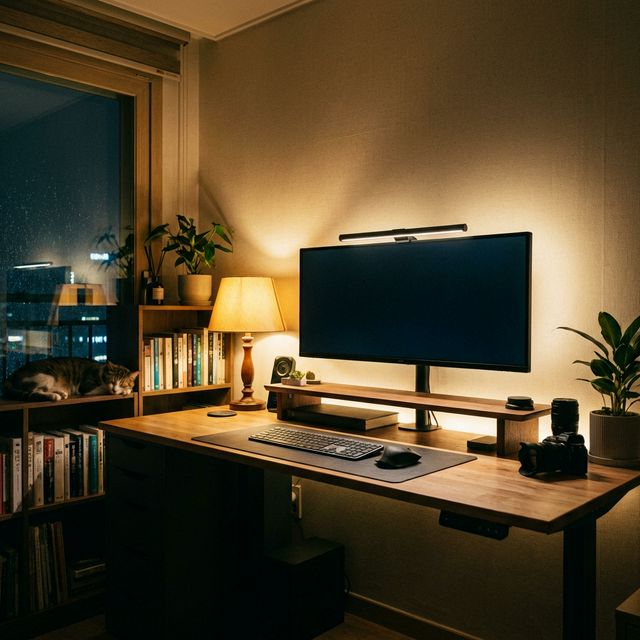
- The Gear: A Monitor Light Bar (BenQ ScreenBar) is best because it takes up zero desk space and causes zero screen glare. Alternatively, an adjustable desk lamp angled away from your eyes.
Layer 3: Accent Lighting (The Vibe)
This separates the desk from the wall.
- The Goal: Create depth and reduce contrast (Bias Lighting).
- The Gear: An LED strip behind your desk or monitor. Set it to a warm white (2700K) or a soft color.
Understanding Color Temperature (Kelvin)
The "color" of your light affects your brain.
- 2700K (Warm/Orange): Relaxing. Use this after 6 PM to help you sleep.
- 4000K-5000K (Cool/White): Focus. Use this during the workday. It mimics daylight and keeps you alert.
- 6500K (Blue/Daylight): Harsh. Avoid this unless you are doing color-critical work.
Recommended Setup
Final Verdict
9.5/10Score
Stop working in the dark. At a minimum, buy a monitor light bar ($40-100) and put a lamp in the corner of your room. Your eyes will feel significantly less tired at the end of the day.
What we like
- Reduces eye strain immediately
- Makes you look professional on video calls
- Separates 'work mode' from 'relax mode'
What could be better
- Good lighting can be expensive to set up